
There is a persistent assumption that a new home built to current Building Regulations is 'energy efficient'. It meets a legal minimum — but that minimum is set well below Passive House, is assessed with a tool that under-predicts real energy use, and is rarely verified on site. Understanding the gap between compliance and performance is essential before you spend money trying to improve a home.
What Building Regulations actually require
In England, the energy performance of dwellings is governed by Part L of the Building Regulations, assessed using SAP. Compliance is demonstrated by showing the design meets target emission and energy rates. The key differences from Passive House are not just numerical — they are about method and verification:
| Aspect | Passive House | Building Regs (Part L) |
|---|---|---|
| Space heating demand | ≤ 15 kWh/m²·yr (hard limit) | No direct fabric-demand limit; emissions-based |
| Airtightness | ≤ 0.6 ACH₅₀ (≈ 0.6 m³/h·m² territory) | Limiting ~8 m³/h·m² @ 50 Pa; ~5 commonly designed |
| Thermal bridges | Each junction modelled, ψ ≤ 0.01 | Default / accredited details, often un-modelled |
| Assessment tool | PHPP (validated against measured use) | SAP (known performance gap) |
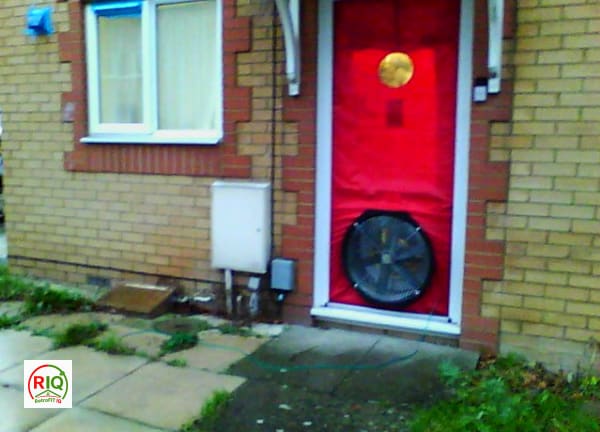
| As-built verification | Mandatory blower door test | Sample airtightness tests; fabric rarely checked |
| Ventilation | MVHR designed & commissioned | Building Regs Part F; commissioning often weak |
The performance gap
The 'performance gap' is the well-documented discrepancy between a building's design-stage predicted energy use and its actual measured energy use once occupied. Studies have repeatedly found new homes using two to three times their predicted heating energy. The causes are systematic:
- As-designed vs as-built — insulation installed with gaps, compressed or missing; details not built as drawn.
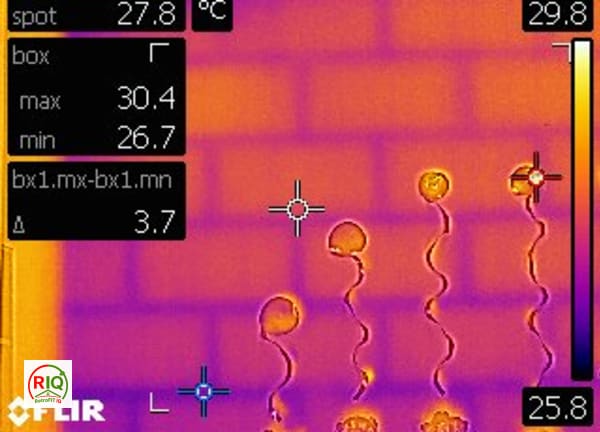
- Un-modelled thermal bridges — junctions that leak far more heat than the default assumptions allow.
- Airtightness assumed but not achieved — sample testing misses the worst units, and workmanship varies.
- Ventilation not commissioned — systems that don't deliver their design flow rates.
- Assessment-tool optimism — SAP's simplifications tend to flatter the design.
Why 'compliant' doesn't mean 'comfortable'
Building Regulations are a minimum standard for health, safety and a baseline of efficiency — they are not a comfort or low-energy specification. A compliant home can still have cold external walls, draughts, condensation-prone reveals and a heating bill far above what the EPC implied. Passive House targets are derived from comfort and moisture safety first, with low energy as the consequence — a fundamentally different design intent.
What this means for your project
- Don't equate 'Building-Regs compliant' or 'good EPC' with 'low energy' or 'comfortable' — they measure different things.
- Insist on measurement: a blower door test tells you what your envelope actually does, not what a calculation assumed.
- Model before you specify: understand the energy balance and the moisture risk of any retrofit measure first.
- Verify after you build: thermal imaging and a post-works airtightness test prove the work delivered what was designed.