
A new-build Passive House starts with a blank sheet — you can optimise orientation, geometry, insulation thickness and junction detailing from scratch. A retrofit cannot. You inherit party walls, intermediate floors built into external walls, projecting bays, conservation constraints, awkward geometry and a building that was never designed to be airtight. EnerPHit is the standard that adapts Passive House rigour to that reality without abandoning the physics that makes it work.
Why retrofit needs its own standard
Forcing a hard ≤ 15 kWh/m²·yr target onto every existing building would be either impossible or absurdly expensive — and in some cases physically unsafe (over-insulating a solid wall internally without managing moisture can do real harm). EnerPHit recognises this by relaxing the heating-demand limit while tightening the things that genuinely protect the building: airtightness, ventilation and moisture control.
The two certification routes
EnerPHit offers two ways to demonstrate compliance, so the standard fits both ambitious whole-house projects and constrained ones:
1. The Energy Demand method
The whole building must meet a heating-demand limit calculated in PHPP — typically ≤ 25 kWh/m²·yr in a cool-temperate climate (the exact figure is climate-dependent). This route gives the designer flexibility in how the target is met across the various elements.
2. The Building Component method
Instead of a whole-building energy figure, each retrofitted element must meet a prescribed performance — maximum U-values for walls, roof, floor and windows, set by climate zone — plus the airtightness, thermal-bridge and ventilation requirements. This route suits constrained buildings where a single whole-building demand figure is hard to reach but each element can be brought up to standard.
| Criterion | Passive House (Classic) | EnerPHit |
|---|---|---|
| Heating demand | ≤ 15 kWh/m²·yr | ≤ 25 kWh/m²·yr (Energy Demand route) |
| Airtightness | ≤ 0.6 ACH₅₀ | ≤ 1.0 ACH₅₀ |
| Compliance routes | Single (demand) | Energy Demand OR Building Component |
| Ventilation | MVHR required | Heat-recovery ventilation required |
| Thermal bridges & moisture | Designed out | Designed out / risk-assessed (often harder) |
Moisture safety is the central challenge
This is the part that matters most — and the part botched retrofits get wrong. When you insulate an existing wall, you change where it sits in the temperature gradient and therefore where water vapour can condense. Insulate a solid wall internally and the original masonry becomes colder and wetter (it now sits outside the insulation), and the interface between the new insulation and the old wall can fall below the dewpoint — producing interstitial condensation you cannot see until mould or decay appears.
EnerPHit-grade retrofit therefore demands hygrothermal assessment — at minimum a condensation-risk analysis (Glaser method to BS EN ISO 13788), and for higher-risk build-ups a transient simulation (e.g. WUFI) that accounts for rain, drying and real material moisture behaviour. We cover the IWI moisture problem in depth in our 'Internal Wall Insulation without causing mould' article.
Retrofit sequencing — the right order of works
Retrofit measures interact, so the order and the design strategy matter as much as the individual products. A coherent EnerPHit-style approach runs roughly:
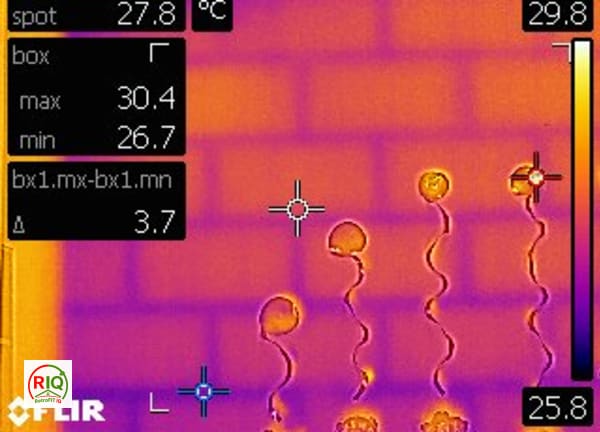
- Survey and model first — measure the existing building (airtightness, thermal imaging, moisture, fabric) and build a PHPP / hygrothermal model before specifying anything.
- Design the continuous air barrier and the continuous insulation layer on paper — apply the 'pen rule' to find every bridge and leak.
- Address fabric: insulate walls, roof and floor with the moisture strategy designed in, not bolted on.
- Detail the junctions — windows set in the insulation plane, insulation returns at party walls and floors, thermal breaks at penetrations.
- Install heat-recovery ventilation (MVHR) sized and commissioned for the now-airtight envelope.
- Size the heat source last — once demand is slashed, the plant is small and cheap.
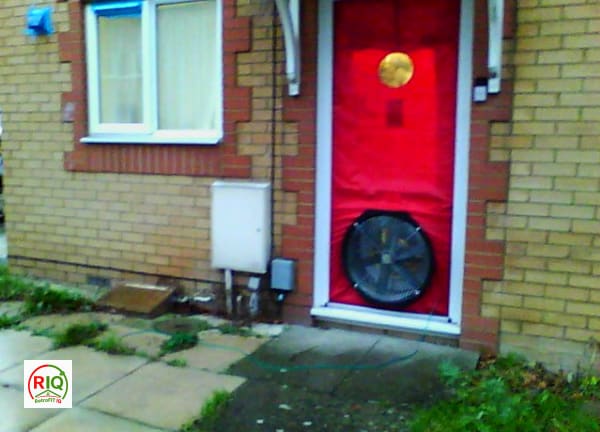
- Verify — blower door test, thermal imaging and (ideally) post-occupancy monitoring to prove the design was achieved.
The hard cases — party walls, bays and conservation
Real buildings fight back. The recurring EnerPHit challenges in UK housing are:
- Party walls — you can only treat your own side; the junction with the neighbour's un-insulated wall is an unavoidable thermal bridge to be managed with insulation returns.
- Embedded joist ends — floor joists built into a solid wall become colder and damper after internal insulation, risking rot; they need careful detailing or local treatment.
- Projecting bays and complex geometry — hard to wrap continuously, prone to bridging.
- Conservation and planning constraints — listed or conservation-area buildings may forbid external insulation or window changes, forcing higher-risk internal solutions that demand even more careful moisture design.
- Staged retrofit — many homeowners retrofit in phases; the danger is a half-finished envelope (e.g. new airtightness without ventilation, or insulation without an air barrier) that performs worse or carries more moisture risk than before. Phasing must be planned as a whole.
Does it have to be certified?
No. EnerPHit certification gives independent verification and resale value, but the physics deliver the comfort, energy and durability benefits whether or not you pay for the certificate. The far more important decision is to adopt the EnerPHit method — model first, build a continuous air barrier, design out thermal bridges, manage moisture, ventilate deliberately, and verify by measurement. That discipline is what separates a retrofit that transforms a home from one that quietly grows mould behind the new plasterboard.