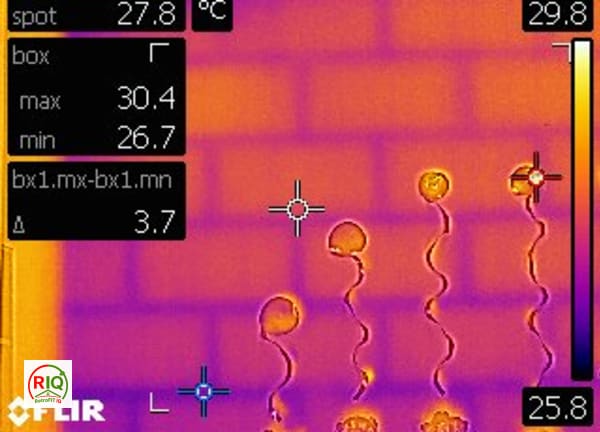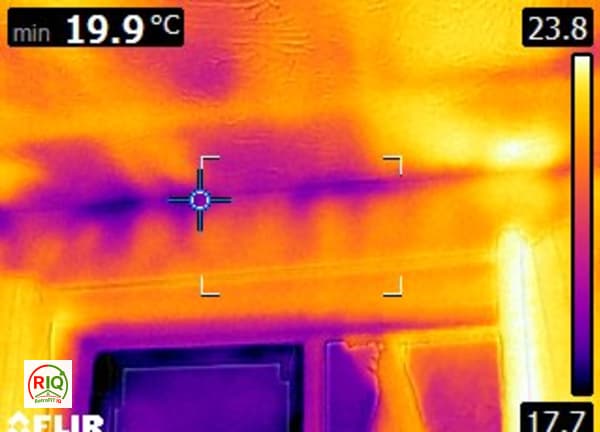

It is tempting to treat the five principles as a shopping list. They are not. They are a system: weaken any one and the others compensate poorly or fail. A super-insulated wall with a thermal bridge at every junction leaks heat and grows mould at the cold spots; a triple-glazed window in a leaky wall still loses heat around its frame; an airtight house without MVHR becomes humid and stuffy. Read them as one strategy.
1. Continuous, high levels of insulation
A Passive House envelope is wrapped in a continuous, unbroken layer of insulation — walls, roof and floor — with no weak spots. The target U-values (the rate of heat loss per square metre per degree of temperature difference) are far below current Building Regulations:
| Element | Typical PH target U-value | Typical UK existing |
|---|---|---|
| External wall | 0.10–0.15 W/m²K | 1.5–2.1 W/m²K (solid brick) |
| Roof | 0.10–0.15 W/m²K | 0.4–2.3 W/m²K |
| Floor | 0.10–0.15 W/m²K | 0.7–1.2 W/m²K |
| Whole window (Uw) | ≤ 0.80 W/m²K | 2.0–5.0 W/m²K |
The word that matters is continuous. Insulation only works if it forms an unbroken blanket; the moment it is interrupted — by a balcony, a steel beam, a wall-to-floor junction — heat takes the shortcut. That shortcut is a thermal bridge, which is why the next principle exists.
2. Thermal-bridge-free detailing
A thermal bridge is any localised path that lets heat bypass the insulation — a concrete lintel, a steel column, a poorly-detailed junction. Thermal bridges do two harmful things: they leak disproportionate amounts of heat, and they create cold internal surfaces where condensation and mould form. Passive House design targets a linear thermal transmittance (ψ, 'psi') of ≤ 0.01 W/m·K at junctions — effectively 'thermal-bridge-free'.
Achieving this means insulating continuously around corners, using thermal breaks where structure must penetrate the envelope, and modelling every awkward junction. We cover the physics, the ψ-value method and worked detailing in the dedicated thermal-bridge-free design article.
3. An airtight building envelope
Air leakage is invisible but expensive. Warm, moist indoor air escaping through cracks carries heat out and risks depositing moisture inside the construction on the way (interstitial condensation). Cold air leaking in causes draughts and cold spots. Passive House requires ≤ 0.6 air changes per hour at 50 Pa (ACH₅₀), verified by a blower door test — roughly ten times tighter than typical new UK construction.
Airtightness underpins the whole standard: it makes heat recovery possible, prevents draughts, and protects the structure from moisture. It is also the single principle most often compromised on site, which is why we test it.
4. High-performance glazing and doors
Windows are the weakest thermal element of any envelope, so Passive House specifies triple glazing with low-emissivity coatings, an inert gas fill (argon or krypton), warm-edge spacers and insulated frames. The whole-window U-value (Uw) target is ≤ 0.80 W/m²K, with an installed value (accounting for the fixing detail) of ≤ 0.85 W/m²K.
But glazing is a balancing act: it must keep heat in (low U-value) while letting useful winter solar gain in (g-value) and avoiding summer overheating (orientation and shading). Getting that balance right is a PHPP modelling exercise, covered in the high-performance windows article.
5. Mechanical Ventilation with Heat Recovery (MVHR)
Once an envelope is airtight, you must ventilate it deliberately. MVHR continuously extracts stale, moist air from kitchens and bathrooms, supplies filtered fresh air to living spaces and bedrooms, and passes the two airstreams through a heat exchanger that recovers 75–95% of the heat that would otherwise be thrown away. The result is constant fresh air with almost no heat penalty.
MVHR is not an optional luxury in Passive House — it is the mechanism that makes airtightness liveable. Without it, an airtight house becomes humid and stuffy; with it, indoor CO₂, humidity and particulates drop measurably. We cover its workings, efficiency and maintenance in the MVHR article.
How the five principles reinforce one another
- Continuous insulation drops the heat demand — but only if junctions are thermal-bridge-free.
- Thermal-bridge-free detailing removes the cold spots where the insulation is interrupted.
- Airtightness stops the heat (and moisture) the insulation is trying to retain from simply leaking out.
- High-performance glazing closes the weakest thermal gap and keeps internal surfaces warm.
- MVHR makes the airtight, well-insulated box healthy to live in and recovers the last of the heat.
Remove any one and the system underperforms. That interdependence is exactly why Passive House is modelled holistically in PHPP rather than specified element-by-element — and why we apply the same whole-system thinking to retrofit.