
Passive House — Passivhaus in the original German — is a voluntary, performance-based standard for buildings that need almost no active heating or cooling. It was formalised by Dr Wolfgang Feist and the Passivhaus Institut (PHI) in Darmstadt in the early 1990s, drawing on earlier superinsulation and low-energy research from North America and Scandinavia. The first certified dwellings, built in Darmstadt-Kranichstein in 1991, are still performing to specification more than three decades later — a level of long-term, monitored evidence almost no other building standard can claim.
Crucially, Passive House is not a construction system, a proprietary product or a 'look'. It is a set of physics-based performance targets, verified by calculation (PHPP) before construction and by on-site measurement (the blower door test) after it. A building either meets the numbers or it does not. That measurability is exactly why it matters to a building-performance consultancy: it replaces opinion and marketing with evidence.
The Passive House performance targets
Classic Passive House certification for new build requires a building to meet hard, measured limits. These are the figures every Passive House Designer works to from the first sketch:
| Metric | Limit | What it controls |
|---|---|---|
| Space heating demand | ≤ 15 kWh/m²·yr | Annual energy needed to keep the building warm |
| Heating load (alternative route) | ≤ 10 W/m² | Peak heating power — small enough to heat via the supply air |
| Airtightness | ≤ 0.6 ACH₅₀ | Uncontrolled air leakage through the envelope at 50 Pa |
| Primary Energy Renewable (PER) | ≤ 60 kWh/m²·yr | Total renewable primary energy for all building uses |
| Overheating frequency | ≤ 10% of hours > 25 °C | Summer comfort / overheating risk |
Treated Floor Area (TFA) — the Passive House internal floor-area metric — is the denominator for these figures. It is calculated to a strict PHI methodology and is typically smaller than gross internal area, which is one reason naïve back-of-envelope comparisons with SAP figures can mislead.
Fabric first: the principle behind the numbers
Passive House achieves these targets through a 'fabric-first' strategy: get the building envelope right before you specify any mechanical system. A Passive House works because heat losses are driven so low that the small remaining demand is trivially met. The five interdependent principles — continuous insulation, thermal-bridge-free detailing, an airtight envelope, high-performance glazing, and mechanical ventilation with heat recovery (MVHR) — are explored in depth in the dedicated articles below.
The order matters. A heat pump bolted onto a leaky, poorly-insulated house is treating the symptom; a Passive House removes the demand first, so whatever heat source remains is small, cheap to run and comfortable. This is precisely the logic we bring to retrofit — reduce the load before you size the plant.
It is fundamentally about comfort and health
The targets are not abstract energy bookkeeping — they are derived from human thermal comfort. PHI set the insulation and glazing standards so that internal surface temperatures stay close to air temperature (no cold walls, no radiant asymmetry, no draughts), and so that no internal surface falls below the dewpoint margin that triggers condensation and mould. A Passive House is specified to be comfortable and moisture-safe; low energy use is the consequence, not the sole aim.
- Even internal surface temperatures — no cold external walls or window reveals.
- No draughts, because the envelope is airtight and ventilation is delivered gently and deliberately.
- Continuous filtered fresh air via MVHR — measurably lower CO₂, humidity and particulates.
- Quiet — a well-insulated, airtight, triple-glazed envelope is also an excellent acoustic barrier.
- Durable — surfaces kept above the dewpoint margin are not at risk of surface condensation or mould.
Certification classes: Classic, Plus and Premium
Since 2015, PHI has used a renewable-primary-energy framework (PER) with three classes that reward on-site renewable generation:
| Class | PER demand | On-site renewable generation |
|---|---|---|
| Classic | ≤ 60 kWh/m²·yr | Not required |
| Plus | ≤ 45 kWh/m²·yr | ≥ 60 kWh/m²·yr (referenced to footprint area) |
| Premium | ≤ 30 kWh/m²·yr | ≥ 120 kWh/m²·yr (referenced to footprint area) |
All three classes share the same uncompromising fabric requirements (≤ 15 kWh/m²·yr heating demand, ≤ 0.6 ACH₅₀ airtightness). The classes differ only in how much renewable energy the building generates and uses. This matters: you cannot 'buy back' a leaky envelope with solar panels — the fabric targets are non-negotiable in every class.
What about existing buildings? (EnerPHit)
Most of the UK's homes are already built, so the larger opportunity is retrofit. PHI's EnerPHit standard applies Passive House principles to existing buildings, where party walls, geometry and conservation constraints make the new-build targets impractical. EnerPHit relaxes the heating-demand limit (typically ≤ 25 kWh/m²·yr in a cool-temperate climate) while keeping the same uncompromising attention to airtightness, thermal bridging, ventilation and — most importantly — moisture safety. We cover this fully in the dedicated EnerPHit article.
Common misconceptions
- "You can't open the windows." You can — MVHR simply means you don't need to for fresh air. Comfort doesn't depend on keeping them shut.
- "It's only for new builds." EnerPHit applies the same physics to existing buildings and is arguably more valuable there.
- "It's about technology." It's the opposite — the technology (the heat source) is minimised because the fabric does the work.
- "It overheats in summer." Overheating is an explicit certification criterion (≤ 10% of hours over 25 °C); a properly-designed Passive House is modelled and shaded to prevent it.
- "It's prohibitively expensive." The fabric costs more; the heating system and running costs are dramatically smaller. On a whole-life basis the gap narrows or closes.
The performance gap — and why measurement is the point
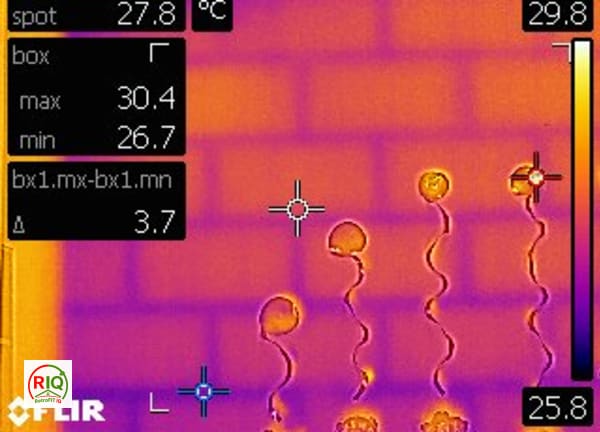
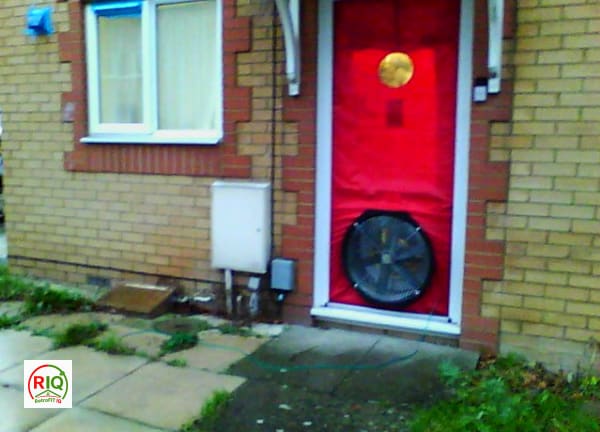
The 'performance gap' is the well-documented gulf between how a building is predicted to perform on paper and how it actually performs once built. UK studies have repeatedly found real energy use far exceeding design-stage SAP predictions, often by a factor of two or more, because workmanship, thermal bridging and air leakage were never measured. Passive House closes this gap by design: the building is modelled in PHPP before construction and verified on site by a blower door test and thermal imaging afterwards. If the as-built airtightness misses 0.6 ACH₅₀, the building does not certify — there is nowhere to hide. This insistence on measured outcomes, not predicted ones, is the single most important idea a building-performance consultancy takes from the standard.
Airtightness in practice: what 0.6 ACH₅₀ really means
Airtightness at 0.6 air changes per hour at 50 pascals is roughly twenty times tighter than a typical existing UK home, which often tests at 10–15 ACH₅₀ or worse. Achieving it requires a continuous air barrier — an unbroken line that can be traced around the whole heated envelope on a section drawing, with every penetration (services, joists, windows) sealed with the right tapes and membranes. The reason it matters is not pedantry: uncontrolled air leakage carries both heat and moisture. Warm, humid air forced through a gap in the envelope cools as it goes and can deposit condensation inside the construction, where it rots timber unseen. Airtightness is therefore as much a moisture-safety measure as an energy one — which is why it is paired inseparably with ventilation.
Thermal bridges, surface temperature and the dew point
Passive House detailing is 'thermal-bridge-free' (a defined criterion, Ψ ≤ 0.01 W/mK at junctions) for a reason that goes beyond energy. A thermal bridge — a junction, reveal or embedded element where heat shortcuts through the fabric — runs colder on its internal surface than the surrounding wall. Every batch of indoor air has a dew point, the temperature at which its moisture condenses out; where a surface falls below that dew point, water condenses and mould follows. By keeping every internal surface warm and above the dew-point margin, Passive House detailing designs out the cold corners, reveals and junctions where condensation and mould otherwise concentrate. This is precisely the failure mode we are called to diagnose in conventionally-built and poorly-retrofitted homes.
MVHR and indoor air quality
Because the envelope is so airtight, a Passive House is ventilated deliberately rather than accidentally, using mechanical ventilation with heat recovery (MVHR). MVHR continuously extracts stale, humid air from kitchens and bathrooms and supplies filtered fresh air to living spaces and bedrooms, passing the two airstreams through a heat-exchange core that recovers up to ~90% of the heat from the outgoing air. The result is measurably better indoor air quality — lower CO₂, controlled humidity in the healthy 40–60% band, and filtered particulates — without the heat penalty of opening windows. In our humid, cool-temperate climate, this controlled moisture management is arguably the standard's most valuable feature for health and durability.
Passive House, heat pumps and MCS
A Passive House or EnerPHit retrofit is the ideal home for a heat pump, because its heat demand is so low that the heat pump can be small and run at a low flow temperature with a high seasonal efficiency. This is the fabric-first principle taken to its conclusion: minimise the load, then the plant almost looks after itself. Where a heat pump is installed, an MCS-certified installer sizes it to the measured, reduced heat loss — and because that load is tiny, the unit, the running cost and the carbon are all minimised. The same logic scales down to ordinary retrofit: even a partial fabric-first upgrade makes any future heat pump cheaper to buy and run.
A worked example: applying the discipline to a UK terrace
Few London terraces will ever be certified EnerPHit — party walls, conservation constraints and budgets see to that. But the discipline still transforms them. Take a solid-wall Victorian terrace that feels cold, suffers window condensation and grows mould in the corners. A Passive-House-informed approach would model the fabric and moisture risk first; insulate the walls (internally, hygrothermally checked, or externally at the rear) to warm the surfaces above the dew point; design out the reveal and junction thermal bridges; build a continuous air barrier and verify it with a blower door test; and add MVHR or continuous extract to manage the moisture the tighter envelope now retains. The home ends up warm, dry, quiet and cheap to heat — not certified, but built on the same evidence-based logic.
Summer comfort and overheating in a warming climate
Passive House is often assumed to be only about keeping warm, but the standard explicitly limits summer overheating too — certified buildings must keep indoor temperatures above 25 °C for no more than 10% of the year. This matters more every decade as UK summers warm and overheating becomes a recognised health risk, particularly in flats and south-facing rooms. The same fabric that keeps winter heat in also keeps summer heat out, but only if the design manages solar gain (shading, glazing orientation and g-values), provides secure night-time purge ventilation, and uses the MVHR system's summer bypass to dump heat overnight rather than recover it. A well-designed Passive House is therefore comfortable in a heatwave as well as a cold snap — whereas a naively 'super-insulated' building with large unshaded south glazing and no purge strategy can overheat badly. This is why overheating analysis belongs in the design from the start, not as an afterthought, and it is increasingly central to good retrofit practice in our changing climate.
What it costs, and what it is worth
Passive House and EnerPHit cost more in fabric — more insulation, better windows, careful detailing and airtightness work, plus MVHR — but dramatically less in heating plant and running costs, and they deliver comfort, health and durability that conventional construction cannot. On a whole-life basis the premium narrows, and in a world of volatile energy prices the low, predictable running cost is a hedge as much as a saving. Just as important, a moisture-safe, mould-free, comfortable home protects both the occupants' health and the building fabric itself — value that never shows up in a simple payback calculation.