
Why ventilation choice matters
Every home needs continuous fresh air. Without it: indoor CO₂ rises (cognitive performance drops), humidity climbs (condensation and mould), VOCs and PM2.5 accumulate (health impact). Opening windows works in theory but fails in practice — it's intermittent, it throws away heating energy and most occupants do it far too little in winter.
The four mainstream strategies all solve this differently. The right choice depends on your airtightness, layout, occupants and budget.
MVHR — Mechanical Ventilation with Heat Recovery
A central unit with two ducted networks — one extracting moist, stale air from kitchens and bathrooms; the other supplying filtered fresh air to bedrooms and living rooms. The two airstreams cross in a heat exchanger; 80–93% of the heat from the outgoing air is transferred to the incoming air without the airstreams mixing.
PIV — Positive Input Ventilation
A single fan in the loft pushes filtered outside air into the central stairwell, slightly pressurising the home and forcing stale air out through trickle vents, extract points and the envelope itself. No heat recovery — incoming air is at outdoor temperature.
dMEV — Decentralised Mechanical Extract Ventilation
Continuous low-rate extract fans in wet rooms (kitchen, bathrooms), with fresh air drawn in passively through trickle vents elsewhere. A pragmatic middle-ground for moderately airtight homes.
Intermittent extract (the worst option)
The default in most existing UK homes — a noisy fan in the bathroom that runs while you shower. Almost completely useless: it only operates 5% of the time, throws away heat, and does nothing about CO₂, low-level humidity or VOCs the rest of the day. We never recommend it for a serious retrofit.
The RetrofitIQ decision framework
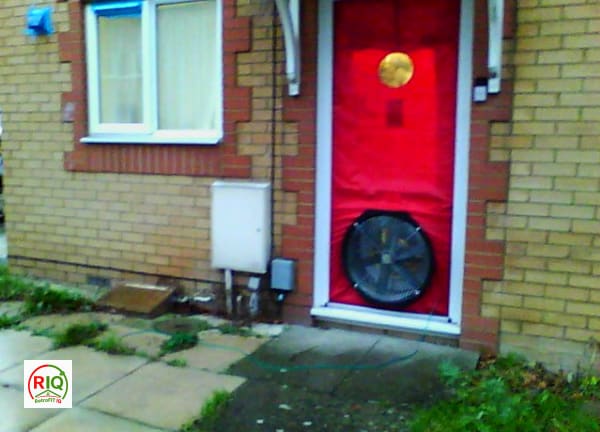
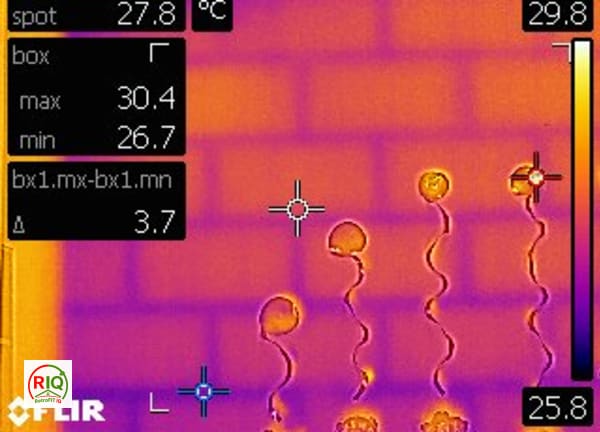
- Blower door test first — establish actual airtightness in ACH₅₀.
- If ≤3 ACH₅₀ and ductwork is feasible → MVHR is almost always the right answer.
- If 3–7 ACH₅₀ → dMEV is the pragmatic choice; consider tightening up to enable MVHR.
- If ≥7 ACH₅₀ and the building can't realistically be made airtight → PIV is the most cost-effective whole-house solution.
- Verify after install with measured CO₂, humidity and a re-test where applicable.