
Older houses 'ventilate' by accident — through draughts, gaps and open chimneys. That uncontrolled leakage is wasteful (you heat air and immediately lose it) and unreliable (too much on a windy day, none on a still one). When you make a building airtight, you remove that accidental ventilation, so you must replace it with a deliberate, designed system. MVHR is the Passive House answer.
What MVHR actually does
An MVHR unit runs two airstreams continuously and simultaneously:
- Extract: stale, warm, moist air is drawn out of the 'wet' rooms — kitchen, bathrooms, utility, WC.
- Supply: fresh, filtered outdoor air is delivered to the 'living' rooms — bedrooms, living room, study.
- Transfer: air migrates from supply rooms to extract rooms through door undercuts, balancing the system.
The two airstreams never mix. They pass through a heat exchanger where the outgoing warm air gives up most of its heat to the incoming cold fresh air — without the two ever touching. You get fresh air at close to room temperature, having paid almost nothing to heat it.
How heat recovery works — the heat exchanger
The heart of an MVHR unit is a counter-flow (or counter-current) heat exchanger: the two airstreams flow past each other in opposite directions through thin separated channels, maximising the surface area and temperature gradient over which heat transfers. The longer the two streams run alongside each other, the more heat is recovered.
PHI-certified MVHR units achieve 75–95% sensible heat recovery (measured to a strict standard that includes fan heat and casing losses — manufacturers' own headline figures are often optimistic). Some units also use an enthalpy (moisture-recovering) core to recover a portion of humidity, useful for avoiding over-dry winter air.
| Parameter | Good Passive House practice | What it tells you |
|---|---|---|
| Sensible heat recovery | 75–95% (PHI-certified method) | How much ventilation heat is recovered, not wasted |
| Specific Fan Power (SFP) | ≤ 0.45 W/(l/s) | How efficiently the fans move air — lower is better |
| Supply filter grade | F7 / ePM1 (fine, particulate-grade) | Whether incoming air is filtered for PM2.5 / pollen |
| Airtightness of the host building | ≤ 0.6 ACH₅₀ | Whether the air actually passes through the unit |
| Filter change interval | ~6–12 months | Maintenance needed to sustain airflow and IAQ |
The components of a system
- The MVHR unit — containing the heat exchanger, two fans (supply and extract), and filters.
- Filters — typically G4/Coarse on the extract and F7/ePM1 (fine, pollen- and particulate-grade) on the fresh-air supply. The supply filter is what makes MVHR an indoor-air-quality measure, not just a ventilation one.
- Insulated ductwork — distributing supply and extract air to each room. Duct sizing and routing are critical: undersized or convoluted ducts cause noise and starve the system.
- Intake and exhaust terminals — fresh air drawn from a clean location, exhaust discharged well away from it.
- A condensate drain — the extract side cools below dewpoint in the unit, so it produces condensate that must drain away.
- Controls — boost for cooking/showering, summer bypass to avoid unwanted heat recovery on warm nights, and frost protection.
Why airtightness is a prerequisite
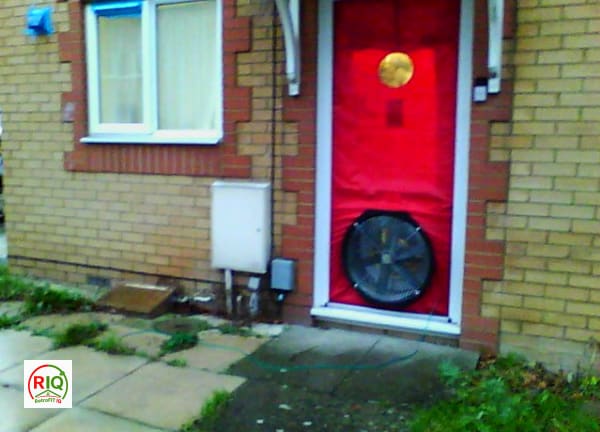
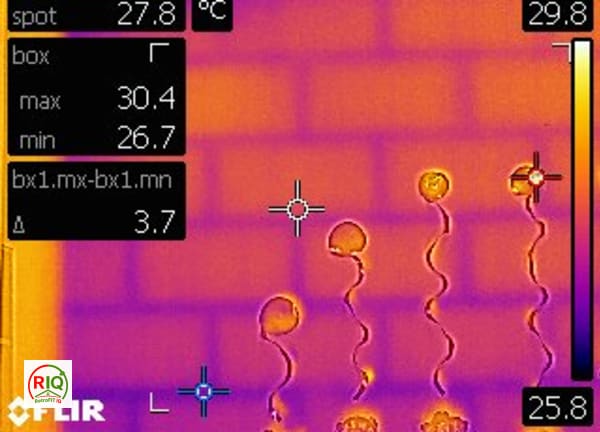
MVHR only delivers its rated heat recovery if the air it controls actually passes through the heat exchanger. In a leaky building, much of the air bypasses the system entirely through cracks and gaps — so you pay for the fans but lose the heat anyway. This is why Passive House couples MVHR with ≤ 0.6 ACH₅₀ airtightness: the two are a matched pair. Installing MVHR in a leaky house is one of the most common — and disappointing — retrofit mistakes.
Commissioning and balancing — where systems fail
An MVHR system is not 'fit and forget'. Once installed, every supply and extract valve must be measured and adjusted (with an anemometer) so the design flow rates are actually delivered and the supply and extract volumes are balanced. An un-commissioned system is the single most common reason for complaints — too little air in bedrooms, too much noise, or an unbalanced unit that pressurises or depressurises the house and undermines its own heat recovery.
- Measure and set every valve to the design flow rate.
- Balance total supply against total extract (within a few percent).
- Check fan power and specific fan power (SFP) — a measure of how efficiently the fans move air.
- Verify boost and summer-bypass operation.
- Hand over a commissioning sheet — without one, you cannot prove the system meets its design.
Maintenance — the bit owners skip
MVHR maintenance is minimal but non-negotiable: change the filters (typically every 6–12 months depending on location and filter grade), and inspect/clean the ducts and unit periodically. A blocked filter strangles airflow, raises fan energy and degrades air quality. The good news is that filter changes are a five-minute job most owners can do themselves.
Common myths
- "MVHR is just air-conditioning." No — it ventilates and recovers heat; it does not actively heat or cool the air (beyond the recovered heat). It moves modest volumes of fresh air, not large cooling loads.
- "It makes the house stuffy / dries the air out." A correctly balanced system continuously delivers fresh air, which makes a house feel fresher, not stuffier. Excessive winter dryness usually means the flow rate is set too high — fixable at commissioning, or with an enthalpy core.
- "It's noisy." Noise indicates undersized ducting, a poorly-sited unit or a system run at boost continuously — all design/installation faults, not inherent to MVHR.
- "I can just use extractor fans instead." Intermittent extract fans remove moisture from one room but recover no heat and provide no filtered fresh supply. They are a different (and far less effective) strategy — see our MVHR vs PIV article.