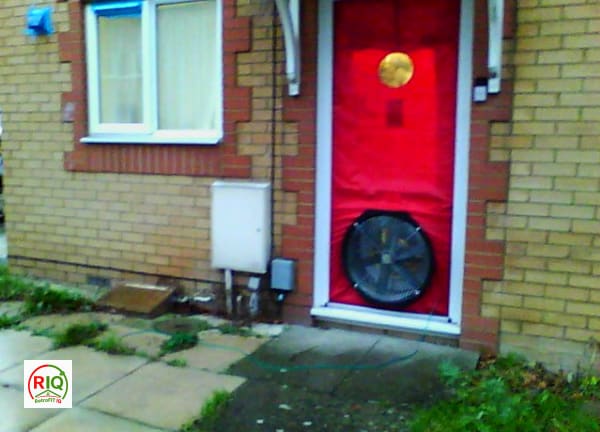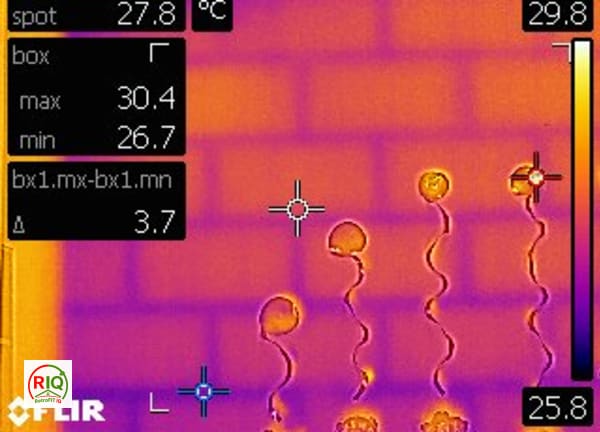

The first question to ask of any airtightness figure is: which metric is it, and at what pressure? Almost all UK results are quoted at 50 Pa, but they may be air permeability (m³/h·m², the Part L metric) or ACH₅₀ (air changes per hour, the Passive House metric). Because the two depend on the building's shape, they are not interchangeable — so always confirm which you're looking at before comparing.
UK benchmarks — where does your building sit?
| Building | Air permeability (q50) | Comment |
|---|---|---|
| Old, un-refurbished housing | 10–15+ | Very leaky; draughty, hard to heat |
| Typical UK new build (Part L) | ~5 | Meets regs; still relatively leaky |
| Good airtight new build | 1–3 | Deliberate air-barrier strategy |
| EnerPHit retrofit (≈1.0 ACH₅₀) | ~1–1.5 | Passive House retrofit standard |
| Passive House (≤0.6 ACH₅₀) | ~0.6 territory | Order of magnitude tighter than regs |
The Passive House and EnerPHit targets
- Passive House (new build): ≤ 0.6 ACH₅₀ — verified by a blower door test, both pressurised and depressurised, averaged.
- EnerPHit (retrofit): ≤ 1.0 ACH₅₀ — relaxed because existing buildings have unavoidable leakage paths, but still far tighter than standard construction.
- Both are mandatory, measured criteria: you cannot certify on a calculation alone. The test must pass.
These targets are not arbitrary. 0.6 ACH₅₀ is the threshold below which the building is tight enough for MVHR to deliver its rated heat recovery, for the heating load to drop to the Passive House level, and for air-transported moisture risk to be controlled. It is a performance threshold, not a badge.
Reading the flow exponent (n)
Beyond the headline number, a full (multi-point) test reports the flow exponent n, the slope of the leakage curve. It is a free diagnostic clue:
- n ≈ 0.5: dominated by large, sharp-edged openings (turbulent flow) — look for obvious gaps and holes.
- n ≈ 0.6–0.7: a typical mix of cracks and small gaps across the envelope.
- n approaching 0.9–1.0: long, narrow, laminar-flow cracks — distributed, diffuse leakage that's harder to chase down.
If two buildings share the same ACH₅₀ but very different n values, their leakage has a different character and may need a different remediation strategy — concentrated sealing of a few big holes versus a more systematic air-barrier approach.
Equivalent Leakage Area (ELA) — the 'hole' you can picture
A blower door can also express leakage as an Equivalent (or Effective) Leakage Area — the size of a single, notional sharp-edged hole that would leak the same amount as all the building's distributed cracks combined. It's a powerful communication tool: telling a homeowner their envelope leaks the equivalent of 'an open A4 sheet of holes' makes an abstract m³/h figure tangible. It is derived from the leakage curve, not measured directly.
Pass vs genuinely good
Meeting the Part L limit is a legal minimum, not a performance target. A house at ~5 m³/h·m² passes Building Regulations but is many times leakier than a good airtight build at 1–3, and roughly an order of magnitude leakier than a Passive House. If your goal is comfort, low bills, effective MVHR and moisture safety, 'compliant' is the floor, not the aim.
Before-and-after testing
On a retrofit, a single 'after' number proves compliance but tells you nothing about what worked. Testing before and after sealing works — or at intermediate stages — quantifies the improvement, validates the air-barrier strategy and catches problems while they're still cheap to fix. We strongly recommend an early-stage test when the air barrier is accessible, not just a final test once everything is boarded and decorated.
From ACH₅₀ to real-world infiltration — the N-factor
A common misreading is to treat ACH₅₀ as the rate at which a home actually exchanges air in everyday conditions. It is not. ACH₅₀ is measured under an artificial 50 Pa pressure that never occurs naturally; real infiltration is driven by the few pascals that wind and the stack effect produce. The rough rule of thumb is the 'N-factor', or LBL division factor: natural seasonal infiltration is approximately the ACH₅₀ divided by a number that depends on climate, exposure and building height — typically around 20 for a sheltered, low-rise UK dwelling, less (so more infiltration) for an exposed or tall one. So a house at 10 ACH₅₀ might actually exchange around 0.5 air changes per hour on an average winter day — useful context when judging whether the building also needs purpose-provided ventilation.
What the number means for MVHR and heat pumps
The airtightness figure is not an abstract score; it sets what other systems can achieve. MVHR only recovers its rated heat if the air it conditions actually passes through the heat exchanger — in a leaky house much of the air bypasses the unit, so a building much above roughly 3 m³/h·m² (and certainly above the Passive House 0.6 ACH₅₀) cannot deliver the efficiency the MVHR is rated for. Similarly, a heat pump is sized on the design heat loss, of which infiltration is a meaningful slice; a tighter envelope means a lower design load, a smaller and cheaper heat pump, a lower flow temperature and a higher seasonal efficiency. Reading a blower door result, then, is partly about asking: is this building tight enough for the ventilation and heating strategy it is meant to support?