
Carpet Underlay vs an Acoustic Floor: A Soft Touch or Real Isolation
Carpet and underlay vs Acoustic floor build-up.
 Reviewed by George Sora, Certified Passive House DesignerUpdated June 2026
Quick answer & key takeaways
4 min read- Bottom line: Carpet and underlay soften footfall at the surface; a proper acoustic floor decouples the structure underneath.
- When Carpet underlay is enough: You want surface comfort underfoot
- When Acoustic floor is the better choice: Footsteps are disturbing the room below
- When you need both: You want comfort and separation
- Biggest misconception: “Thick underlay soundproofs the floor.” — It cushions surface impact but does not decouple the structure, so the thud still transmits to the room below.
- Retrofit IQ’s approach: We distinguish surface cushioning from structural isolation: carpet and underlay soften footfall at the surface but do not decouple the floor, so where impact noise reaches the room below we design a resilient build-up rather than relying on a soft finish.
Quick answer
Carpet and underlay soften footfall at the surface; a proper acoustic floor decouples the structure underneath. Underlay helps a little with high-frequency, surface-level impact, but it does not break the vibration path into the joists, so the thud of footsteps still transmits below. A designed acoustic floor uses a resilient layer, mass and absorption to isolate that path — which is the difference between a softer step and a genuinely quieter room below.
At a glance
| Attribute | Carpet and underlay | Acoustic floor build-up |
|---|---|---|
| Acts at | Surface only | Whole structural path |
| Decouples structure | No | Yes |
| Impact noise below | Slightly reduced | Substantially reduced |
| Cost / effort | Low | Higher |
| Depth | Minimal | Greater |
| Best for | Surface comfort, minor improvement | Real acoustic separation between floors |
What is Carpet and underlay?
A soft floor finish that cushions footfall at the surface, reducing the sharpness of impact and some high-frequency noise. It is cheap and easy, but it does not isolate the structure beneath.
What is Acoustic floor build-up?
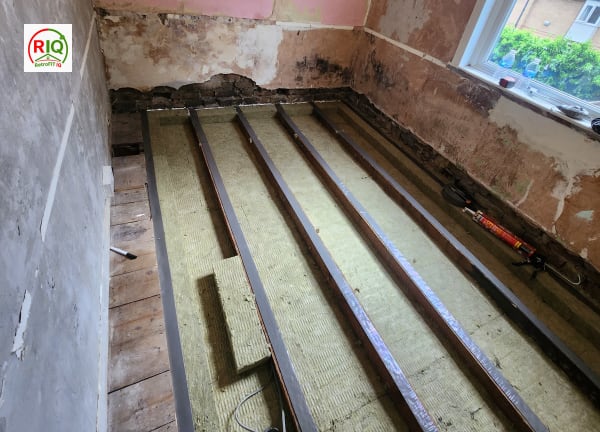
A designed build-up using a resilient layer to decouple the walking surface from the structure, plus mass and absorbent infill, genuinely reducing impact-noise transmission to the rooms below.
What each method measures — and what it doesn’t
Carpet underlay
- Cushions footfall at the surface
- Reduces some high-frequency surface impact
- Adds comfort underfoot
- Structural decoupling
- Meaningful reduction of low-frequency thud below
Acoustic floor
- Decouples the walking surface from the structure
- Substantially reduces impact noise below
- Combines resilient layer, mass and absorption
- A no-depth, low-cost quick fix
The building science
Impact noise has two parts: the sharp, high-frequency surface contact, and the low-frequency thud that travels into the structure. Carpet and underlay act on the first — a soft surface cushions the contact and takes the edge off — but they do nothing about the second, because the floor remains rigidly connected to the joists below. The heavy thud of footsteps passes straight through.
A proper acoustic floor addresses the structural path. A resilient layer decouples the walking surface so vibration is isolated rather than transmitted; mass resists the energy, and absorbent infill damps the cavity. Designed together, these substantially reduce the impact noise reaching the room below, including the low-frequency component that underlay cannot touch.
This is why underlay so often disappoints when the complaint comes from the flat below. The occupant of the room with the carpet feels a softer step, but the neighbour still hears the thuds, because the energy is entering the structure regardless of the soft surface. Surface comfort and structural isolation are different problems.
The trade-off is depth and cost. Carpet and underlay are cheap, slim and easy; an acoustic floor needs build-up height and careful edge detailing to avoid bridging. Where the goal is genuine separation between floors, the acoustic build-up is the only thing that delivers it — underlay is a comfort upgrade, not a soundproofing solution.
Key differences
- Underlay softens the surface; an acoustic floor decouples the structure.
- Underlay barely reduces the thud heard below; an acoustic floor does.
- Underlay is cheap and slim; an acoustic floor needs depth and detailing.
- Surface comfort and structural isolation are different objectives.
Common misconceptions
Myth: Thick underlay soundproofs the floor.
It cushions surface impact but does not decouple the structure, so the thud still transmits to the room below.
Myth: Carpet is enough to stop footsteps annoying the flat below.
The low-frequency impact passes into the joists regardless of a soft surface. Real isolation needs a decoupled build-up.
Myth: An acoustic underlay equals an acoustic floor.
A thin acoustic underlay helps marginally; a designed build-up with a resilient layer, mass and absorption performs in a different league.
Real-world situations
Neighbour below complains about footsteps
A proper acoustic floor build-up to decouple the structure; underlay alone will not solve their complaint.
You want a more comfortable surface underfoot
Carpet and underlay are fine for surface comfort if structural noise below is not the issue.
Refurbishing a flat above occupied rooms
Design an acoustic floor with a resilient layer and edge detailing; do not rely on carpet for separation.
Minor improvement wanted, no rooms below
Underlay may be all that is needed where impact transmission is not a concern.
Which do you actually need?
When Carpet underlay is enough
- You want surface comfort underfoot
- There are no rooms below to disturb
- Only a minor improvement is needed
When Acoustic floor is the better choice
- Footsteps are disturbing the room below
- You need genuine impact separation
- You are refurbishing above occupied space
When you need both
- You want comfort and separation
- A carpet finish sits over a decoupled acoustic build-up
What Retrofit IQ checks on site
We distinguish surface cushioning from structural isolation: carpet and underlay soften footfall at the surface but do not decouple the floor, so where impact noise reaches the room below we design a resilient build-up rather than relying on a soft finish.
- Identification of impact noise and its transmission path
- Assessment of available depth for an acoustic build-up
- Specification of a resilient decoupling layer with mass and infill
- Edge and perimeter detailing to prevent rigid bridging
- Flanking-path checks at junctions and the party floor
- A finish (including carpet) chosen over the decoupled build-up
What a Certified Passive House Designer recommends
Carpet and underlay make a floor feel nicer to walk on; they do not soundproof it. The thud that annoys the neighbour below is structural, and a soft surface does not break the path into the joists. For real separation you need a decoupled build-up — resilient layer, mass and absorption — and the carpet can then go on top.
The frequent disappointment is fitting thick underlay to solve a complaint from downstairs and finding it barely changes. That is physics, not bad luck: surface comfort and structural isolation are different jobs, and only the acoustic floor does the second.
— George Sora, Certified Passive House Designer, Founder, RetrofitIQ
Reviewed using current building physics principles and Passive House methodology.
Related comparisons
Related investigations
Compare another way
Closely related comparisons our clients read next.
Acoustic Mineral Wool vs PIR Insulation
Mineral wool absorbs sound; PIR is a rigid thermal board that reflects it.
Read comparisonFloating Floor vs Direct-Fix Floor
A floating floor decouples the walking surface from the structure with a resilient layer, isolating impact noise; a direct-fix floor is rigidly connected, so footsteps transmit straight through.
Read comparisonResilient Bars vs Independent Wall System
Resilient bars partially decouple a lining from the structure; an independent wall fully separates it.
Read comparisonAirborne vs Impact Soundproofing
Airborne noise (voices, TV) is controlled mainly with mass, absorption and decoupling; impact noise (footsteps) is controlled mainly by decoupling and resilient layers.
Read comparisonEvidence from Real Projects (14)
Real project and investigation images from our own fieldwork, matched to this page — not stock photography.



No related investigations yet.
Browse all investigationsFrequently asked questions
Does carpet underlay soundproof a floor?+
It cushions surface impact and reduces some high-frequency noise, but it does not decouple the structure, so the thud of footsteps still transmits to the room below.
Why does my neighbour still hear footsteps through carpet?+
Because the low-frequency impact enters the joists regardless of a soft surface. Real isolation needs a decoupled acoustic floor build-up.
What is a proper acoustic floor?+
A designed build-up with a resilient layer that decouples the walking surface from the structure, plus mass and absorbent infill, substantially reducing impact noise below.
Is acoustic underlay the same as an acoustic floor?+
No. Thin acoustic underlay helps marginally; a full build-up with a resilient layer, mass and absorption performs far better.
When is carpet and underlay enough?+
When the goal is surface comfort and there are no rooms below to disturb, or only a minor improvement is needed.
How much depth does an acoustic floor need?+
More than carpet and underlay; the build-up depends on the target and structure. We balance performance against available headroom.
Can I keep a carpet finish?+
Yes — a carpet can be laid over a decoupled acoustic build-up, combining surface comfort with genuine structural isolation.
Will it stop airborne noise too?+
With mass and absorption in the build-up it can help airborne noise as well, but its main job is impact-noise isolation.
What ruins an acoustic floor's performance?+
Rigid bridging at edges or penetrations, which short-circuits the decoupling. Careful perimeter detailing is essential.
Who designs the build-up?+
A Certified Passive House Designer, so decoupling, mass, absorption and detailing are designed together to actually reduce the noise below.
Need professional advice?
A comparison like this helps you understand the theory, but every property behaves differently. The only reliable way to establish the real cause in your home — rather than guessing — is professional building performance diagnostics. At RetrofitIQ we verify buildings using the appropriate combination of investigations:
- Thermal imaging
- Blower door testing
- Moisture investigation
- Building physics assessment
- Passive House methodology