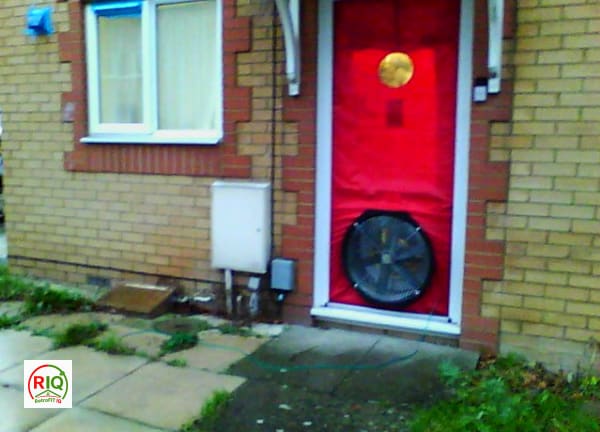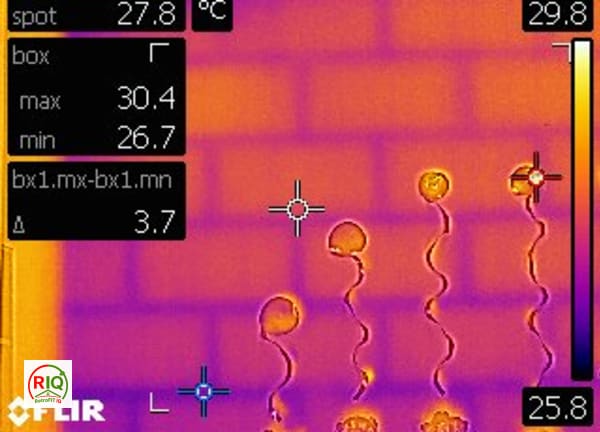

The principle is simple: seal a calibrated fan into a doorway, use it to create a known pressure difference across the building envelope, and measure the airflow required to maintain it. The more airflow needed, the leakier the building. The skill — and the standards — lie in doing this accurately, repeatably and with the building prepared correctly.
The equipment
- A calibrated, variable-speed fan (e.g. a Minneapolis BlowerDoor or Retrotec) with interchangeable flow rings to cover a wide range of building leakiness accurately.
- An adjustable door panel and frame that seals the fan into an external doorway.
- A two-channel digital manometer / pressure gauge (e.g. a DG-700) measuring both the building pressure (inside vs outside) and the fan pressure, from which airflow is derived.
- Software or a calibrated calculation to convert fan pressure to airflow and fit the results.
- Ancillary kit for leak detection: smoke pencils/puffers, a smoke fogger, an anemometer and a thermal camera (used under depressurisation).
Pressurisation vs depressurisation
The fan can blow air into the building (pressurisation) or draw it out (depressurisation):
- Depressurisation sucks air out, so outdoor air is pulled in through every leak — ideal for leak detection, because you can feel and trace incoming draughts and run a thermal camera to see cold air entering.
- Pressurisation pushes air out through the leaks — useful for smoke-tracing leaks from outside and for cross-checking.
- Best practice (and most standards) is to test in both directions and average the two, because some components (flaps, dampers, overlapping materials) behave differently depending on flow direction.
Single-point vs multi-point (regression) tests
There are two levels of test:
Multi-point (the proper, standardised test)
The fan is stepped through a series of pressure differences — typically from about 50 Pa down to 10–25 Pa in increments — and the airflow is recorded at each. Plotting airflow against pressure produces the building's leakage curve, which follows the power law Q = C·ΔPⁿ, where C is the flow coefficient and n is the flow exponent. Fitting this curve gives both the airflow at exactly 50 Pa (Q₅₀) and the flow exponent n, which itself tells you something about the nature of the leaks. This is the method required by BS EN ISO 9972 and ATTMA for a certified result.
Single-point
A quick measurement of airflow at one target pressure (50 Pa), assuming a typical flow exponent. It is useful for snagging, before-and-after comparison during sealing work, and quick diagnostics — but it is less accurate and not a substitute for a full multi-point certified test.
The governing standards
| Standard | Scope |
|---|---|
| BS EN ISO 9972 | The test method itself (replaced BS EN 13829). Defines procedure, equipment and calculation. |
| ATTMA TSL1 | Technical Standard for measuring air permeability of dwellings (UK). |
| ATTMA TSL2 | Technical Standard for non-domestic buildings (UK). |
| Approved Document L | The Building Regulations requirement that triggers testing and sets the limit. |
BS EN ISO 9972 also defines the test 'methods': Method 1 (the building in its in-use state), Method 3 (the building envelope, with intentional openings such as trickle vents and extract fans deliberately sealed) — the method matters because it changes what is and isn't sealed before testing, and therefore what the result represents.
Preparing the building — what to seal and what not to
Preparation is where results are won or lost, and where bad testing inflates numbers dishonestly. The principle is that you temporarily close 'intentional' openings (because they are designed to be controllable) but you must NOT seal up accidental leaks you're trying to measure:
- Close (but don't permanently seal) all external windows and doors; set internal doors open so the whole volume is tested as one zone.
- Temporarily seal designed ventilation openings appropriate to the test method: trickle vents, extract fan terminals, cooker hoods, passive stack vents.
- Deal with traps and drains: fill or cap dry traps (e.g. unused gullies, washing-machine standpipes) that would otherwise read as leaks.
- Turn off and, where required, temporarily seal combustion appliance flues and open fireplaces per the standard.
- Crucially, do NOT tape over service penetrations, downlights, loft hatches, skirting gaps or other accidental leaks — those are exactly what the test exists to measure. Sealing them is, frankly, cheating the result.
Calculating the result — area and volume
To convert the measured airflow at 50 Pa into ACH₅₀ or air permeability, the tester must accurately calculate the internal volume (for ACH₅₀) and the total envelope (surface) area — walls, roof and ground floor — to the ATTMA measurement conventions. Errors in these geometric inputs directly distort the headline number, which is one reason a competent, accredited tester matters.
| Quantity | How it's obtained |
|---|---|
| Q₅₀ (airflow at 50 Pa) | From the fitted leakage curve (multi-point regression) |
| ACH₅₀ (n50) | Q₅₀ ÷ internal volume |
| Air permeability (q50) | Q₅₀ ÷ total envelope area |
| Flow exponent (n) | Slope of the log-log leakage curve |
Common sources of error
- High wind — gusts above roughly 6 m/s (Beaufort 3–4) destabilise the baseline and the standard limits testing in strong wind.
- Large indoor/outdoor temperature difference — exaggerates stack effect and baseline drift.
- Incorrect or sloppy preparation — sealing the wrong things, or leaving designed openings open.
- Geometry errors — mis-measured volume or envelope area skew ACH₅₀ / q50.
- Testing a single direction only, or relying on a single-point test where a certified multi-point is required.
- Drained traps or open flues left unaddressed, reading as phantom leaks.
Reading the leakage curve — C and n
The multi-point test does not just give a single airflow at 50 Pa; it fits the whole leakage curve to the power law Q = C·ΔPⁿ, and both fitted constants carry meaning. C, the flow coefficient, scales with the overall size of the leakage — a bigger, leakier building has a larger C. n, the flow exponent, describes the character of the leaks, from about 0.5 (large, sharp-edged openings, turbulent flow) to near 1.0 (long, narrow, laminar cracks). A good tester checks the quality of the curve fit (the correlation coefficient) as a measure of test reliability: a clean, repeatable curve with a high correlation indicates stable conditions and a trustworthy result, while a scattered curve warns that wind or operator error has disturbed the measurement. The standards set minimum correlation criteria precisely so that a poor-quality test cannot be passed off as valid.
Baseline pressure and why it is measured first
Before the fan is even switched to test speed, the gauge records the baseline (natural) pressure difference across the envelope — the few pascals produced by wind and the stack effect on the day. This baseline is averaged over a period and subtracted from every subsequent reading, so the reported airflow reflects only the pressure the fan applied, not the weather. If the baseline is large or unstable (a windy day, a big temperature difference), its variability dominates the uncertainty, which is why BS EN ISO 9972 limits testing to conditions where the baseline is small enough to subtract reliably. A test run without a proper baseline capture, or in conditions that breach the standard's wind limits, is not defensible however tidy the headline number looks.
Zone pressurisation for large or complex buildings
A single fan in one doorway tests a building as one volume, which works for a typical dwelling. Larger or compartmentalised buildings — blocks of flats, terraces with shared voids — need more care, because leakage between a flat and its neighbours (party-wall and party-floor leakage) is real heat loss but is not 'to outside'. Guarded-zone or compensated testing runs fans in adjacent zones to neutralise the pressure across the party elements, isolating the leakage to the genuine exterior. Getting this right matters for both compliance and for diagnosing party-wall bypass, a major and frequently-missed heat-loss path in UK terraces and semis.